Building on someone else's platform: Why WhatsApp?
I've worked in ad tech for years, mostly on Google Ads and Apple Ads. Recently, a different channel caught my attention: WhatsApp.
Turkish e-commerce companies now use WhatsApp to reach customers directly, for order tracking and for seasonal campaigns to those who opted in. Part of what used to happen over email is moving here. Common for years in Latin America and India, this is just taking hold in Turkey.
Meta provides the infrastructure through the WhatsApp Cloud API but no interface for sending campaigns, so most companies go through Meta's partners.
A new marketing channel means a new market, and with my background, I want to solve its users' problems. So I started building a product on it. Here's why, from a product perspective, I chose a market where one platform owns both the rules and the infrastructure.
Building on a large platform's infrastructure has a name: the aftermarket. In the auto industry, once a car is sold, a second market forms around it for parts, accessories and repairs. Software works the same way: Shopify apps, Salesforce add-ons, or the independent platforms many companies use to run Apple Ads instead of Apple's own dashboard. These products fill the gaps the platform leaves, like a better interface or a missing feature. Think of lemonade on a hot day. The lemon grower doesn't quench your thirst — a place like Liva Patisserie, a well-known Ankara pastry shop, does, by turning the lemons into lemonade.
Platforms leave these gaps on purpose. The full solution isn't worth the operational load, so they open their APIs and hand some of their customers' problems to the market. The companies building on the infrastructure capture the value that handoff creates.
The companies building on the infrastructure capture the value that handoff creates.
But these companies rarely become blockbusters: the real growth belongs to the channel's owner, who also sets the rules. So the goal isn't to steer the market but to stay aligned with the platform, keep customers as long as possible, and hold on to the value created.
That's why this kind of market rarely suits founders chasing VC money. A product whose limits the platform sets will struggle to deliver the 5–7x return investors expect. But for steady revenue and a hard-to-copy advantage built on expertise, it makes a lot of sense.
After years in ad tech, I believed my network and domain knowledge could create value here, so I'm building a WhatsApp campaign management platform.
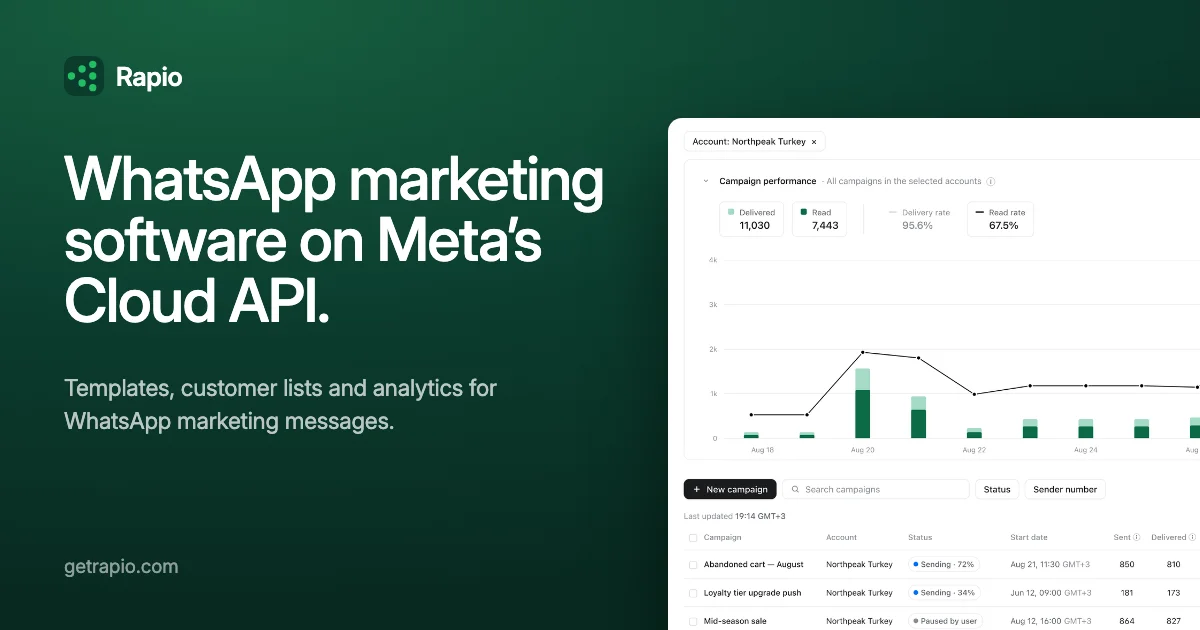
Technically, it's a layer on top of the Cloud API. The real question is what kind of product that layer becomes. A standard email marketing tool is a bulk sending engine: upload a list, write a message, hit send. Google Ads is built around campaigns: setting them up and showing their results. Marketers think in campaigns, so a WhatsApp platform built that way matches how they already work.
It will also cover the Cloud API's gaps. Some analytics only go back three months, while users want at least twelve, and Meta offers no advanced campaign dashboard for WhatsApp. My main focus, though, is what happens after a campaign is sent: tracking and measurement. What's the right way to measure campaigns on this channel, and what does it take?
None of this shows up in the API documentation; it surfaces over time, through running campaigns and listening to users. That's why domain expertise matters so much in product work. I wouldn't look to my accountant for a great cybersecurity product. Understanding these needs well enough to build well-shaped solutions takes time, and that's where knowing the domain helps most.
Understanding these needs well enough to build well-shaped solutions takes time, and that's where knowing the domain helps most.
- Aftermarket products sit on top of large markets, with many users ready to convert. You don't build the market from scratch.
- Large markets also draw many competitors.
- Anyone can copy features; the real difference is domain expertise.
- Don't just wrap the API; shape it around your users' mental model. Marketers think in campaigns, not bulk sends. A product that speaks their language beats one that only adds features.
- API dependency is unavoidable and can block development. A well-designed API makes all the difference.
- The company's value is capped by its position; the platform draws the boundaries, so set expectations accordingly.